

Infection Prevention and SPD: Q&A With IP Expert Garrett Hollembeak, CRCST, CIS, CHL, CER, CIC
Two households, both alike in dignity–infection prevention and sterile processing–rely on one another to ensure patient safety. IP and SPD expert Garrett Hollembeak takes us through how to forge a strong partnership between the two entities, and points out crucial organizational strategies that make the difference between health and infection.
South Lebanon, Ohio–Infection prevention (IP). It’s not the same as sterile processing, yet the work done by IP professionals and sterile processing department (SPD) professionals accomplishes a similar goal.
Still, collaboration between these two entities has a lot of room to grow, and the stakes are high.
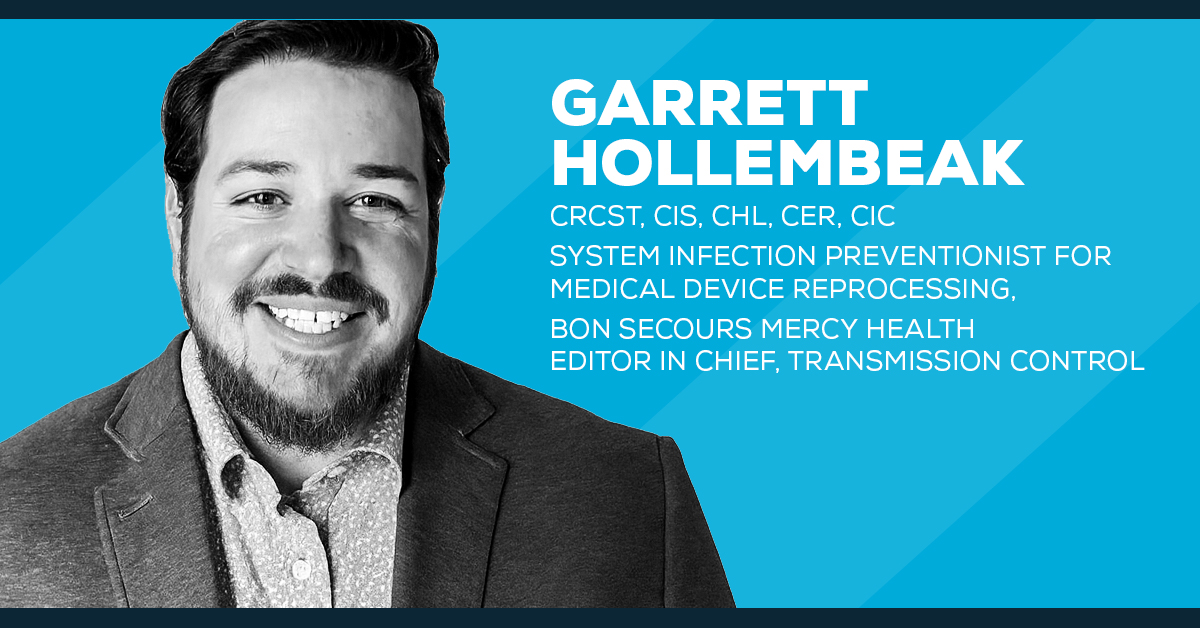
According to Garret Hollembeak, CRCST, CIS, CHL, CER, CIC, System Infection Preventionist for Medical Device Reprocessing at Bon Secours Mercy Health and Editor in Chief of Transmission Control, the extent of collaboration between IP and SPD can make all the difference for patient and population safety.
Hollembeak has spent his career at the intersection of infection control and sterile processing. It’s there, at this intersection, where he believes a major opportunity for partnership lies–one with the potential to change lives.
To get at the root of how to foster strong collaboration between IP and SPD, the team at SterileBits sat down with Hollembeak to gather his expert insights. Here’s what he had to say.
SterileBits: What impact does SPD have on infection prevention?
Hollembeak: A lot of my educational background is focused on epidemiology, and I have experience working in SPDs. When I was an SPD manager, I worked at a large children’s hospital that saw hundreds of cases each day. When you aggregate all those thousands of cases, the combined total is the size of a mid-sized city in the US. That’s where we get into population health. The instruments that SPD processes every day not only affect individual patients, but also the widespread health of entire populations, which is what we deal with in infection prevention.
SterileBits: In an ideal world, how would SPD and IP work together?
Hollembeak: Typically, we see two models for the way SPD and IP interact. In one model, infection prevention and sterile processing are very involved with each other. Each department has visited the other, not just for audits or environment of care walkthroughs. IP has spent time watching a tray get processed in decontamination and interacting with the staff. Getting that comfort level up is important for both sides.
The other kind of model that we see, which is less preferable, is that infection preventionists may not know about sterile processing. They don’t interact with the team members, the frontline staff, until something goes wrong. We want IP to see sterile processing as a partner, because we can’t have safe surgery without good sterile processing.
SterileBits: How do we bridge the gap between IP and SPD?
Hollembeak: The first step is to get out of our comfort zones. Sometimes, we go into new spaces wondering: Am I dressed right? Do I have the right PPE? It’s okay to not know, but if we never learn, then nothing changes.
Instead of coming in and making recommendations about something you may or may not know about, we want IPs to draw on the knowledge base that sterile processing supervisors and managers already have.
It’s perfectly appropriate to go down to SPD and say, “I don’t know anything about this space,” or “This space is very different than the last facility I worked at, so please walk me through what you do. Tell me everything,” and let them take you under their wing.
Starting with “I would love to work with you,” as opposed to coming in and trying to make changes right away, makes a huge difference in relationship building and in the effectiveness of infection prevention efforts.
SterileBits: What is the biggest cause of infection that originates in sterile processing?
Hollembeak: Outside of gross negligence, one of the biggest risk factors is the late delivery of trays. It’s not one we think about very often, but because extended time under anesthesia is an independent risk factor* for the development of surgical site infections, we know that not having everything ready for an on-time case start means the patient is under anesthesia longer.
Not having enough inventory or not turning trays fast enough are issues that are sometimes viewed as operational, but they directly impact the patient on the table. We need to listen to sterile processing professionals and give them the resources and time they need to meet the demands of OR schedules.
SterileBits: What are some ways that infection prevention can support the work of SPD?
Hollembeak: While SPDs may not be actively visiting end users, IPs typically have oversight of clinics that receive instruments from sterile processing. There’s a great opportunity for IP to go to wound care, ENT clinics, dental clinics, or labor and delivery, for example, to assess the quality of sterile storage.
We can check if the packaging is intact, if the temperature and humidity parameters are appropriate, or if instruments are being stored in a way that will continue to be safe if they stay on the shelf for a while.
We see it all the time where a peel pack goes out to a clinic, and it’s not tracked or monitored. It’s very challenging to know when it gets to the clinic if it’s going to be stored appropriately, which makes it challenging for the clinic staff to have good acceptance criteria. If we send a group of instruments and a couple of them are missing indicators, or there are punctures in the peel packs due to an instrument not being appropriately protected, it’s tough to say whether those challenges would be caught without good training for appropriate acceptance criteria on the end-user side. That’s what IP can–and should–help with.
SterileBits: If you could wave a magic wand, what is one thing you would change about SPD and/or IP?
Hollembeak: When it comes to the operational side of things, it’s so important to size your operating room (OR) schedule according to your sterile processing department’s capacity. We’re always adding ORs. We’re always adding clinics and new services. SPD is not always upgraded in kind. So, we’ll arrive at a situation where SPD is over capacity.
SPD technicians are some of the most dedicated people. They will do whatever needs to be done to turn around instruments for the patients. But it’s not fair, healthy, or sustainable to ask SPD professionals to work in overdrive long-term.
So, if there were one operational change for a system to make, I would say build your OR schedule around sterile processing, as opposed to packing in as many cases as you can and assuming SPD can accommodate.
SterileBits: What’s one thing you wish everyone knew about IP and SPD?
Hollembeak: The need for IP to know more about sterile processing is not going away. Don’t be afraid to ask questions. It also doesn’t have to happen in a formal capacity. Talk to your local IP or SPD manager. Ask if you can shadow them for a day and see what the job is like.
SterileBits: Protect Your Peel Pack
Did you learn something from this article? Tell us about it by tagging us @SterileBits on LinkedIn or Facebook.
To read more articles similar to this one, visit the Blog on www.sterilebits.com and follow up on LinkedIn and Facebook.
Interested in learning how SterileBits instrument protectors can protect the sterility of instruments from SPD to end user? Visit the Products page or contact us here.
*Many studies, including Cheng H, et. al.’s study, Prolonged operative duration is associated with complications: a systematic review and meta-analysis., published in the Journal of Surgical Research on April 24, 2018, confirm that prolonged operative duration is associated with an increased risk of complications.